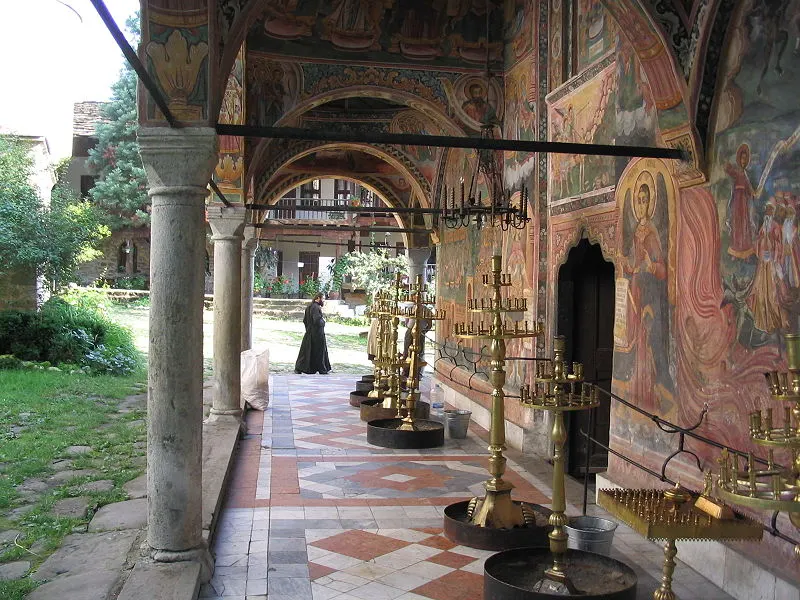
Troyan Monastery of the Dormition of the Mother of God is the third largest monastery in Bulgaria, founded around 1600. Its rich collection of icons includes many works by painters of the Tryavna school, such as the miracle-working icon of the “Holy Virgin of the Three Hands”. The monastery’s feast day is 15 August, celebrated with a great vespers and a procession with the shroud of the Virgin, a symbol of the tomb of the Mother of God. On the weekend around 15 August there is also the traditional crafts fair, where craftsmen from all over the country show their work. Besides folk art, visitors can buy practical pottery for the home, enjoy fairground attractions and taste traditional food in the shady beer gardens.
The monastery also houses a museum dedicated to Vasil Levski, the Apostle of Freedom. The cell where revolutionary plans were discussed has been preserved in its original state.
The St Nicholas hermitage belongs to Troyan Monastery and lies about a kilometre south-east of it, on the western slope of Ivan Dyal peak (1046 m). The church was built in 1812 and the newer living quarters in 1950–60 by Archimandrite Yosif Minkov. It has a remarkable finely carved iconostasis by masters of the Samokov woodcarving school. The monastery yard holds the ossuary of the haydut Velko of Shumen, who died of his wounds in 1848, and there is a holy spring with healing water. The climb to the hermitage is an attraction in itself, and the hermitage is a listed cultural monument.
National Exhibition of Arts and Crafts — the only exhibition in the country that brings together the work of Bulgarian craftsmen from every ethnographic region. It has nine halls covering 4,200 m² and shows unique woodcarving, traditional hand-woven rugs and kilims, pottery, copperware, knitting and embroidery. It is 2 km from the house.
Natural history museum in Cherni Osam village — with more than 700 exhibits. The first hall shows large mammals such as wolves and bears, with recordings of their calls and of the songbirds of the region. Another hall has most of the bird species, and the insect hall is the most popular of all. The museum aims to teach love and care for nature and the species that remain, as many of the animals on display are no longer found here.
Zelenikovo Monastery — founded in 1832 by Partheniy, then abbot of Troyan Monastery; burned down and rebuilt. The complex consists of a church and several living and farm buildings, the oldest surviving one dating from 1872. The church is a three-nave, single-apse, single-dome pseudo-basilica with an open narthex and a bell tower above it. The monastery still has no electricity or running water, and for more than 20 years it has been looked after by one elderly woman, Granny Danka. It cannot be reached by car: after the area became a water-protection zone for several towns and villages, the dirt road to the nearby Yavorova Laka hut was closed. To get there, drive from Cherni Osam village towards the mountains for 3–4 km to the Cherni Osam hydro power station. Opposite it, behind a blue shed, a very well marked path leads to the monastery in about two and a half hours. The first 30 minutes are steep; then the path passes a spring with a resting place, reaches the hamlet of Glushka, crosses Leshnishki Dol, climbs to its highest point and descends to the monastery.
Museum of Folk Arts and Crafts in Troyan — after visiting the museum you can stroll along the newly built crafts street next to it, where you can see and buy the work of the famous Troyan craftsmen. It is the first stage of the “Charshiyata” ethnographic crafts and trade complex.
Sostra fortress and the Roman road — the remains of the ancient Roman fortress of Sostra lie right by the road to Troyan (if you turn off the E772 towards Troyan), no more than 50 m from it along a well-paved stretch. You can park in front of the fortress, where signs and an information board explain the ruins. The fortress stood on the important Roman road Via Traiana and was a military camp.
Kolyu Ficheto’s covered bridge in Lovech links the new part of the town with the Varosha architectural and historical reserve. It is the only one of its kind on the Balkan Peninsula; Europe has only three similar bridges, in Lucerne, Florence and Erfurt. The covered bridge is the official symbol of Lovech, and its little shops sell all kinds of souvenirs of the town and the region. It was built in 1874–1876, burned down in 1925 and rebuilt in 1931. It is 106 m long.
Devetashka Cave — if you enjoy caving and the hidden beauty of the underground world, Devetashka Cave belongs on your list. It lies on the right bank of the Osam river and impresses with its enormous size: the entrance, 35 m wide and 30 m high, leads to a hall of 2,400 m², the largest cave foyer in Europe, up to 100 m high in places. Seven openings in the ceiling let in natural light that illuminates the main hall and parts of the two branches; the largest is known as Kilika. Beyond the main hall the cave splits in two. The left branch, about 2.5 km long, carries a small stream that forms a cascade of natural pools and little waterfalls, crosses the main hall and flows into the Osam. The right branch is dry, warm and much smaller, and ends in a round chamber known as the Altar. Thanks to its good living conditions — easy to defend, spacious, naturally lit, with running water — the cave was inhabited in seven different eras and served as a sanctuary in antiquity.
Krushuna waterfalls, Maarata park — at the northern edge of the Devetaki plateau, 34 km east of Lovech, near Krushuna village in Letnitsa municipality, are the Krushuna falls (Maarata): the largest travertine cascade in the country, with many steps and pools and a rich variety of plants and animals. The site in the southern part of the village includes a huge tufa rock massif and the Maarata river, which forms a remarkable 15 m karst waterfall. You can see every kind of karst landform — karren, sinkholes, dry and blind valleys, a gorge, potholes, cave galleries and halls.
Vidimsko Praskalo eco trail — the trail starts in the Vidima quarter of the town of Apriltsi. The route is especially scenic and reveals much of the beauty of the Balkan Mountains. It is about 16 km long and will delight anyone who loves nature, fresh air and long walks. Vidimsko Praskalo is part of the Severen Dzhendem reserve in the Central Balkan National Park, with a great variety of plants and animals, beautiful landscapes and natural landmarks. The walk takes nearly 4 hours, but you will be so taken with the mountains that you will hardly notice. The terrain is easy, with no dangerous sections. The route runs through cool, dense beech forest along the Praskalska river and leads to the waterfall of the same name, one of Bulgaria’s treasures: at 80 m it is the second highest in the country after Rayskoto Praskalo. The rocks around it attract climbers every year. Below the waterfall a large stream invites you to sit, cool off in summer or have a picnic. The trail is a charming maze of little wooden bridges and beautiful views, with a rest and picnic area and a special corner where children can learn about nature. Information boards along the way describe the plants and animals of the area.
Sopot reservoir — the fourth largest in Bulgaria, 20 km away. It lies in the central part of the Fore-Balkan, about 30 km north-west of Troyan and 35 km south-west of Lovech. Built in 1961, it is 7 km long, up to 2 km wide and 28 m deep, and its water is used for irrigation. Its main tributary is the Kalnik river, a tributary of the Vit. Anglers can catch perch, bleak, silver and common carp, crucian carp, pumpkinseed, rudd, bream, catfish, pike and chub. The reservoir flooded land belonging to the villages of Lesidren and Golyama Zhelyazna.
Troyan Pass (Beklemeto) — a mountain pass in the western part of the Troyan-Kalofer section of the Balkan Mountains, at 1525 m. The road over it, one of the highest in the range, links Karnare village in southern Bulgaria with Troyan in the north. It has many sharp bends, but the views are incredible. Near the pass, a 15-minute walk east of its highest point, stands the Arch of Freedom on Goraltepe peak: a 35 m concrete arch dedicated to the “Russian and Soviet liberators”. It is reached by a narrow paved road on the southern side of the ridge, across the wide pastures of Kostov Polugar. Its reliefs show Bulgarian haydut rebels and partisans, and Russian and Soviet soldiers being greeted with bread and salt by women in folk costume in 1878 and 1944. From the platform you can see the valleys of the Beli Osam and Troyan to the north, Sredna Gora, the Rhodopes and Rila to the south, and the best-known peaks of the Balkan Mountains to the east and west, including the highest, Botev (2376 m).